

AI Architecture
What Is an AI Agent, Really?
And what is the difference between an LLM, an agent, and an agent harness?
There is a lot of sloppy language floating around AI right now.
People say “agent” when they mean “LLM.” They say “agent system” when they mean “some code that calls GPT.” And “agent harness” sounds like something you would buy at Home Depot.
Let’s clean it up.
The Clean Mental Model
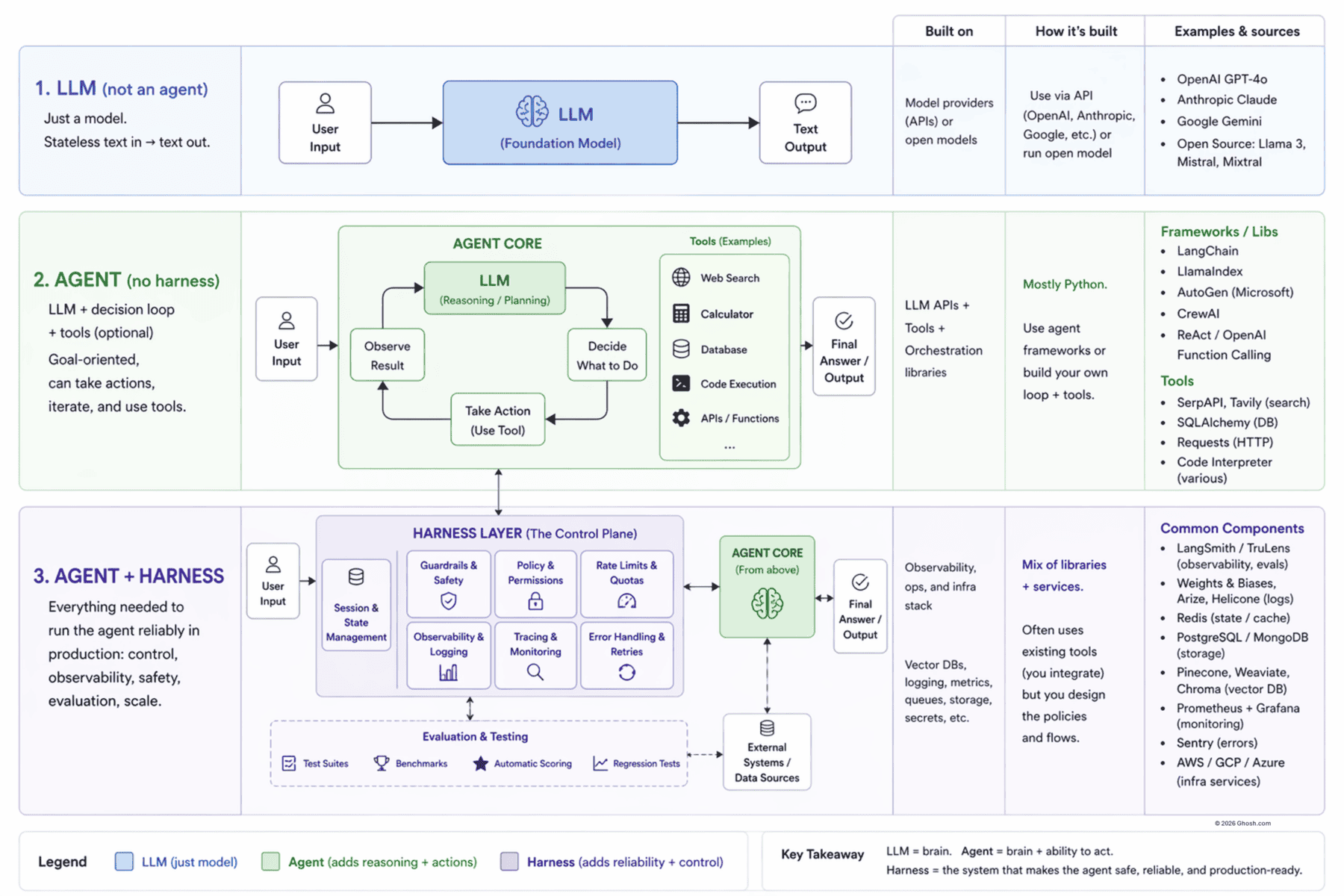
1. The LLM: Just the Brain
An LLM by itself is not an agent.
It is a model. You give it input. It gives you output.
The model is powerful, but by itself it is mostly a very smart text transformation engine.
That is useful. But it is not an agent yet.
2. The Agent: When the Model Starts Acting
An agent starts when you wrap the LLM in behavior.
The key difference is that the agent has some version of a goal, a loop, a policy, and tools.
This can be very simple. It is often just Python or TypeScript, a prompt, an API call, and a loop.
What Agents Are Usually Built On
Most agents are not magic. They are software.
| Piece | What it does | Commonly built with |
|---|---|---|
| LLM | Reasoning, planning, language generation | OpenAI, Anthropic, Gemini, Llama, Mistral |
| Agent loop | Decide, act, observe, repeat | Python, TypeScript, LangChain, AutoGen, CrewAI |
| Tools | Let the agent take action | APIs, databases, code execution, web search |
| Memory | Stores context and prior information | Redis, Postgres, vector databases |
You can build this from scratch. Or you can use agent frameworks. The frameworks help with the shape of the system, but they do not remove the need to understand what is happening.
3. The Harness: The Part That Makes It Real
Most agent demos look impressive because the happy path works.
Production is not the happy path.
The harness is the layer around the agent that handles reliability, safety, monitoring, testing, and operations.
This is where the work gets serious.
What Lives in the Harness?
What the Harness Is Built With
So no, the harness is usually not one magical library. It is a combination of libraries, services, and custom rules that match your business.
Build vs. Buy
The practical answer is: buy what is generic, build what is specific.
| Layer | Usually buy/use | Usually custom-build |
|---|---|---|
| LLM | Model API or open model | Prompting and model selection logic |
| Agent | Frameworks and tool abstractions | Workflow, goals, permissions, business logic |
| Harness | Logging, tracing, eval, monitoring tools | Risk controls, approval flows, success criteria |
The Common Failure Mode
A team builds a cool demo. The demo works. Everyone gets excited. Then it goes into production and starts breaking in boring, predictable ways.
Why?
Because they built the LLM call and maybe the agent. They did not build the harness.


Leave A Comment