


How the next generation of software won’t just be built by AI — it’ll be driven by users, at the speed of thought.
The Unfinished Revolution
We’ve spent two decades shrinking the distance between “idea” and “live.”
In the 2000s, shipping software meant quarterly releases, change advisory boards, and weekends spent praying your deployment wouldn’t break production. The CI/CD movement changed everything — automated testing, continuous integration, deployment pipelines. Elite teams today deploy multiple times per day with change lead times under an hour.
But here’s the thing: we automated the delivery loop and left the decision loop untouched.
A user still submits a feature request into a black hole. A product manager still manually prioritizes a backlog against strategic goals. An engineer still context-switches from their current work to pick up the next ticket. The pipeline is fast — but the handoffs between human decision-makers are still slow, political, and unpredictable.
The next revolution isn’t faster CI/CD. It’s removing the human bottleneck between “someone wants something” and “it’s live.”
The Three Loops — And Why They Don’t Connect
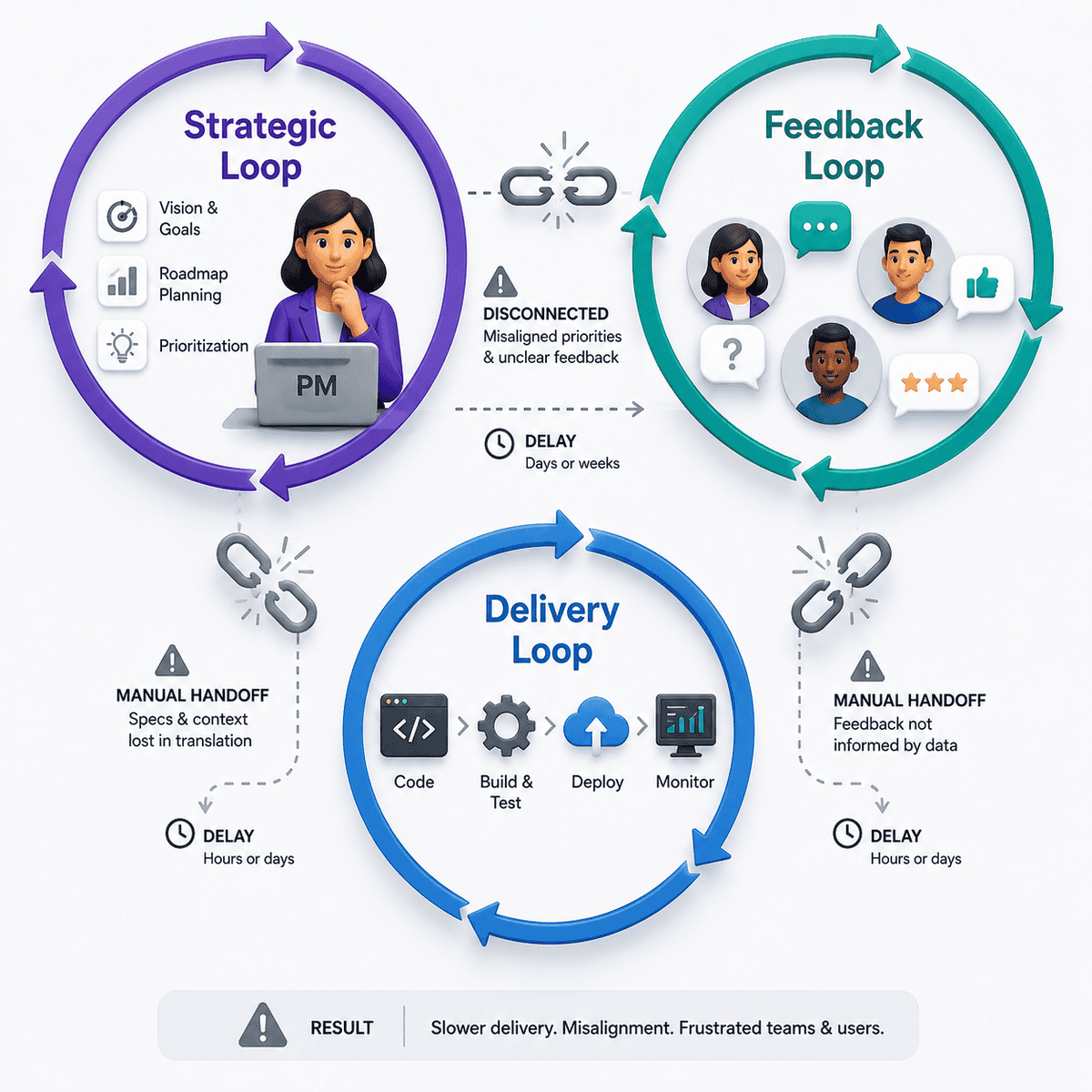
Modern SaaS operates on three parallel cycles that rarely intersect cleanly:
The Strategic Loop: Product managers translate business goals into quarterly roadmaps, OKRs, and capability investments. This moves at the speed of planning cycles — weeks to months.
The Feedback Loop: Users submit requests, upvote features, report bugs, and complain on Twitter. This moves at the speed of human attention — real-time, chaotic, and often ignored until it reaches a critical mass.
The Delivery Loop: Engineers build, test, and deploy. Thanks to CI/CD, this now moves at the speed of automation — hours to days for elite teams.
The problem? These loops run on different clocks, and the handoffs between them are entirely manual. A brilliant user insight sits in a support ticket for weeks before a PM sees it. A strategic priority gets de-prioritized because engineering is heads-down on last quarter’s commitments. The delivery pipeline is a Ferrari — but it’s stuck in traffic between human decision-makers.
DORA’s research tells the story: elite performers deploy on demand, multiple times per day, with lead times under an hour. The technology for fast delivery exists. What’s missing is the intelligence to decide what to deliver, at the speed the technology allows.
The Data: How Fast We’ve Already Gotten
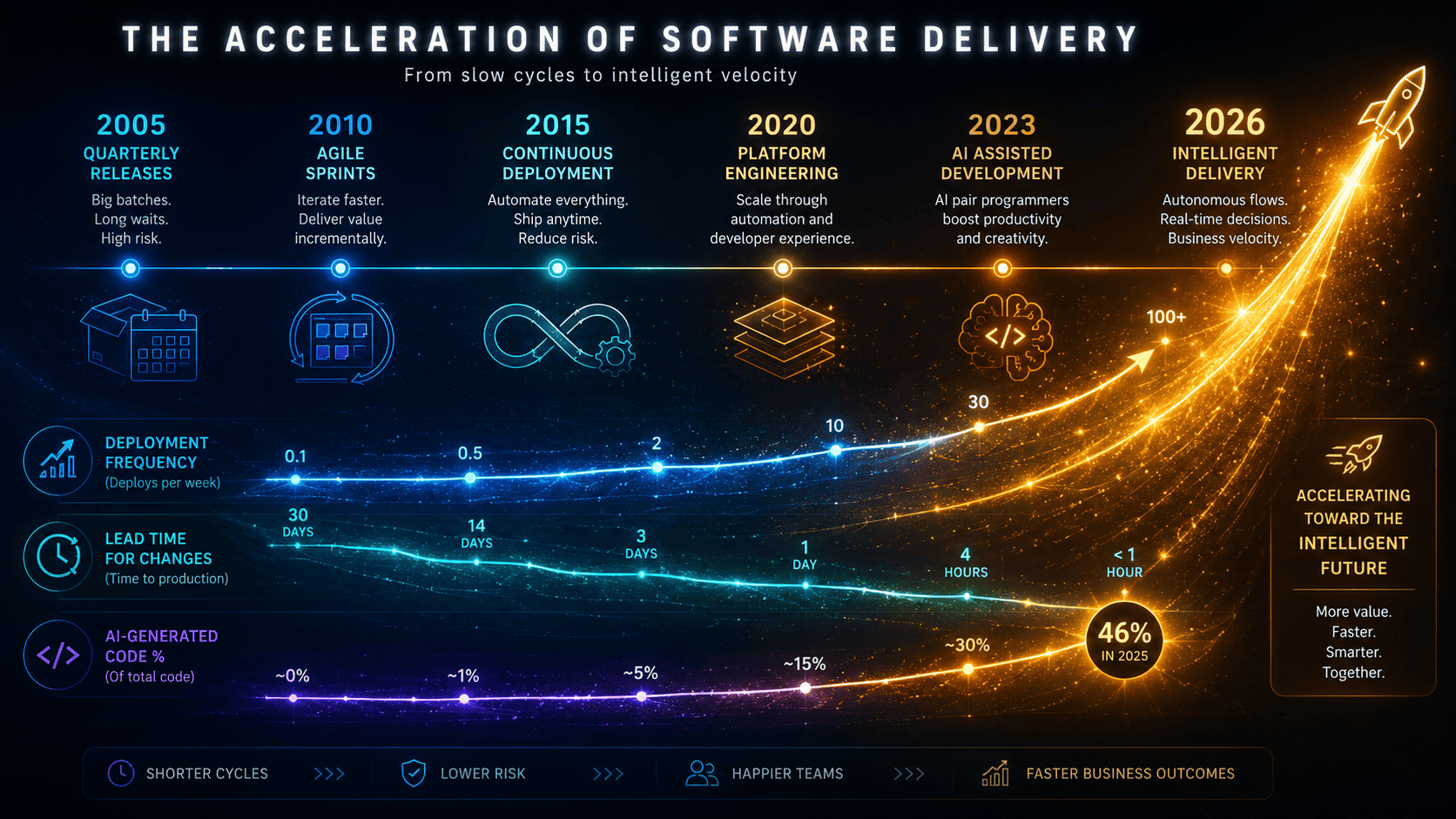
The numbers are staggering — and they point to a clear conclusion.
CI/CD maturity has compressed delivery timelines by orders of magnitude. DORA’s decade of research shows elite performers deploy multiple times per day with change lead times under one hour. Low performers? Once per month or less, with lead times stretching to months. That’s not a 2x improvement — it’s a 100x+ gap in delivery velocity.
AI is already writing nearly half of all code. GitHub Copilot’s verified statistics show 46% of code is now AI-generated on average, reaching 61% in Java projects. In controlled tests, developers using AI assistants complete tasks 55% faster. Accenture’s randomized trial found an 8.69% increase in pull requests per developer and 4x faster PR review times.
AI agents are moving from experimentation to production. In 2026, 57% of enterprises already run AI agents in production. Gartner predicts 40% of enterprise applications will include task-specific agents by 2026, up from under 5% in 2025.
The bottleneck is no longer technical — it’s human. We have the tools to build fast. We don’t have the systems to decide fast.
The Vision: A Self-Running Development Flywheel
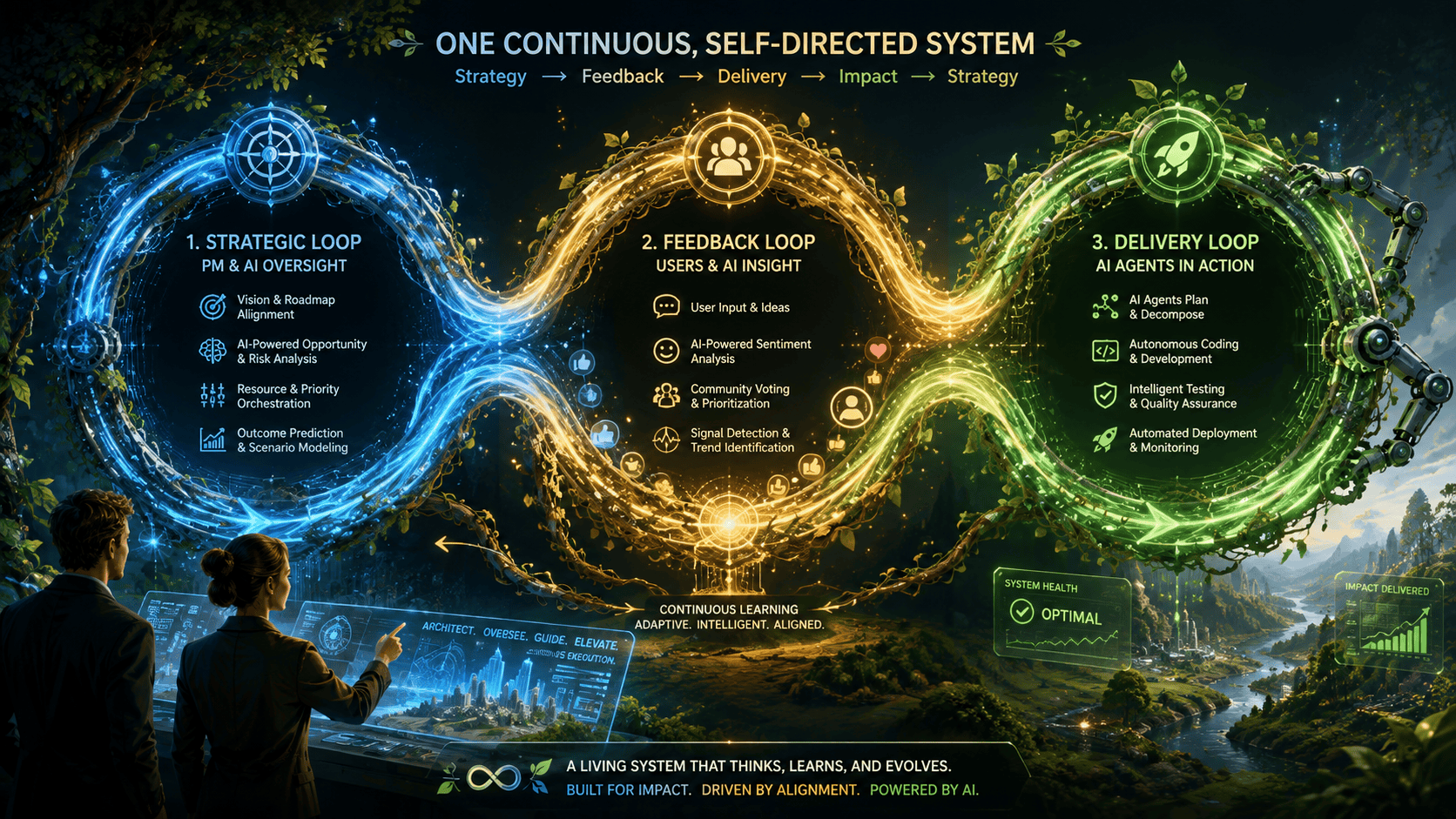
Imagine a SaaS product where the gap between “user wants” and “feature live” is measured in minutes, not quarters.
Here’s how it works:
The User→Development Loop Runs Itself
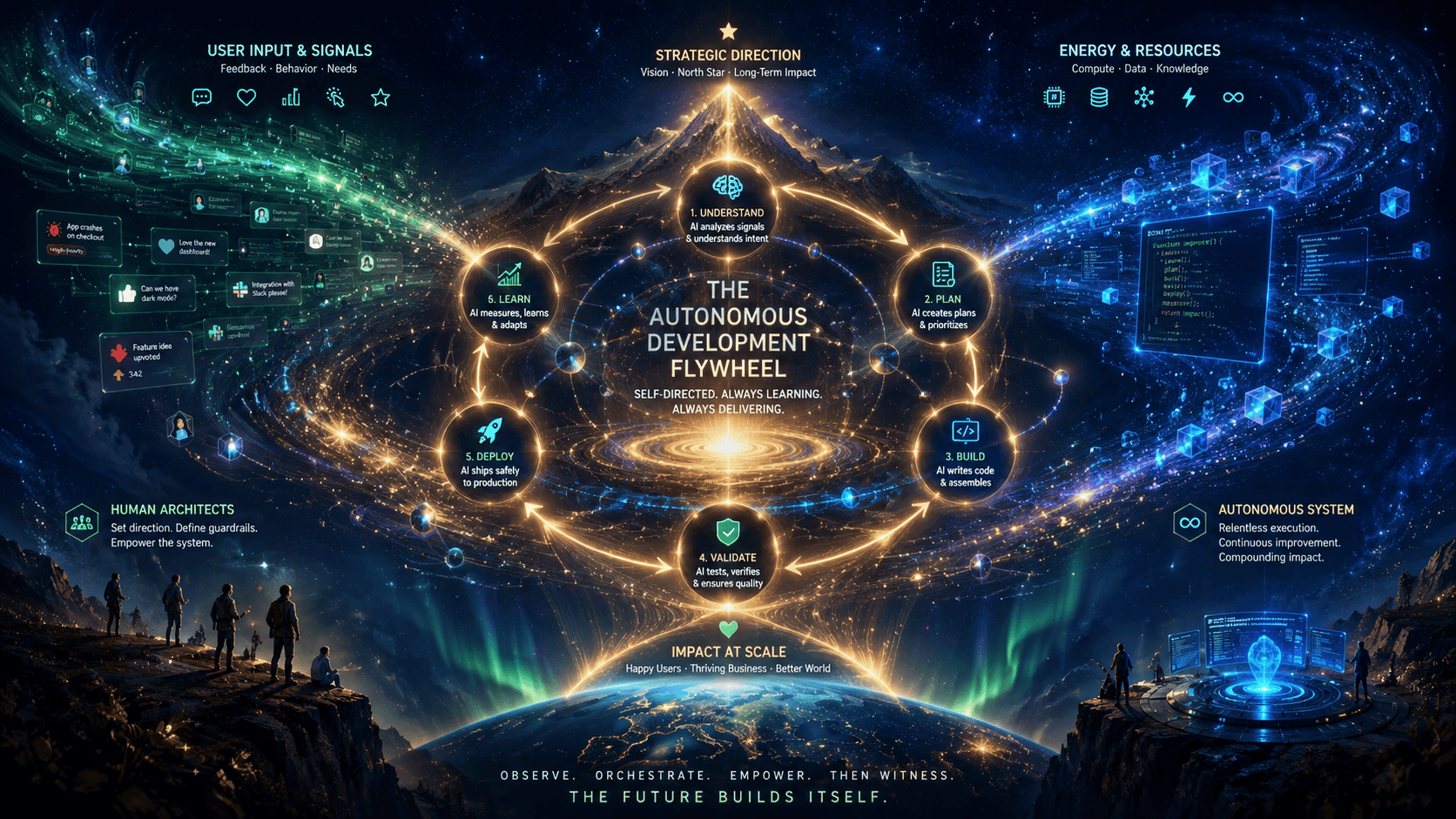
Users submit requests, report bugs, and vote on features through the product itself. AI systems analyze sentiment, cluster similar requests, detect urgency patterns, and automatically prioritize based on impact scoring. No manual triage. No backlog grooming meetings. The queue is alive, self-organizing, and continuously optimized.
When a bug report comes in, AI triages it, reproduces it, identifies the root cause, writes a fix, runs tests, and deploys — potentially within minutes. When a feature request hits a voting threshold, AI scopes the implementation, breaks it into tasks, codes it, tests it, and ships it — hours, not sprints.
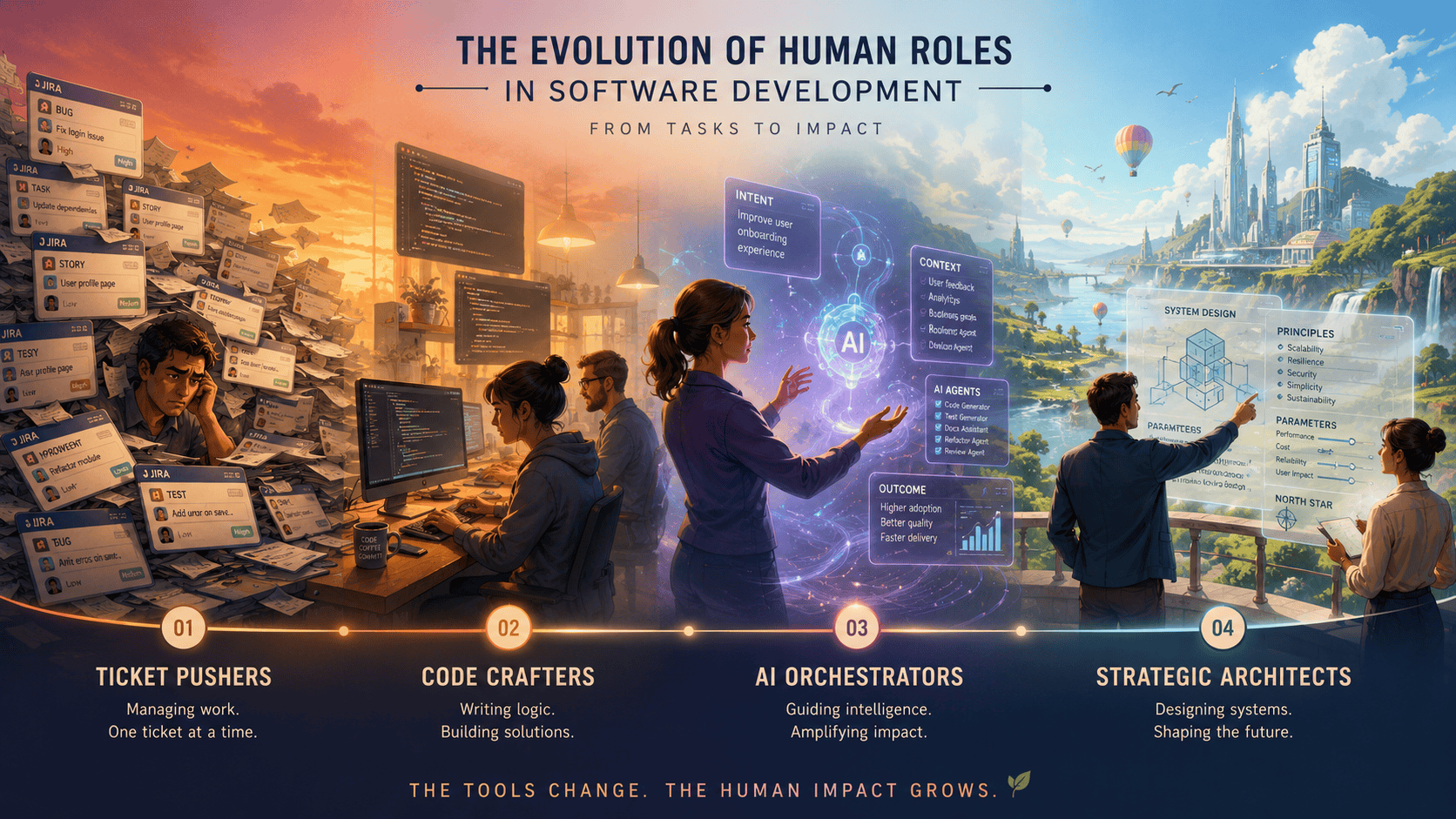
Product Managers Become Strategic Architects
PMs don’t disappear — they evolve. Instead of manually prioritizing tickets, they define the strategic parameters: weighted categories, risk tolerances, business constraints, and architectural guardrails. They inject strategic priorities into the flywheel, and the autonomous loop executes against those parameters.
The PM’s job shifts from “what should we build next?” to “what should the system optimize for?” They become queue architects, not backlog owners.
The Economics of Speed
In this model, delivery speed becomes a function of compute budget and risk tolerance, not human capacity. Want faster turnaround? Allocate more compute to the AI execution layer. Need higher confidence? Dial up the testing and verification gates. The constraint moves from “how many engineers do we have?” to “how much are we willing to spend per unit of delivery?”
What This Actually Looks Like
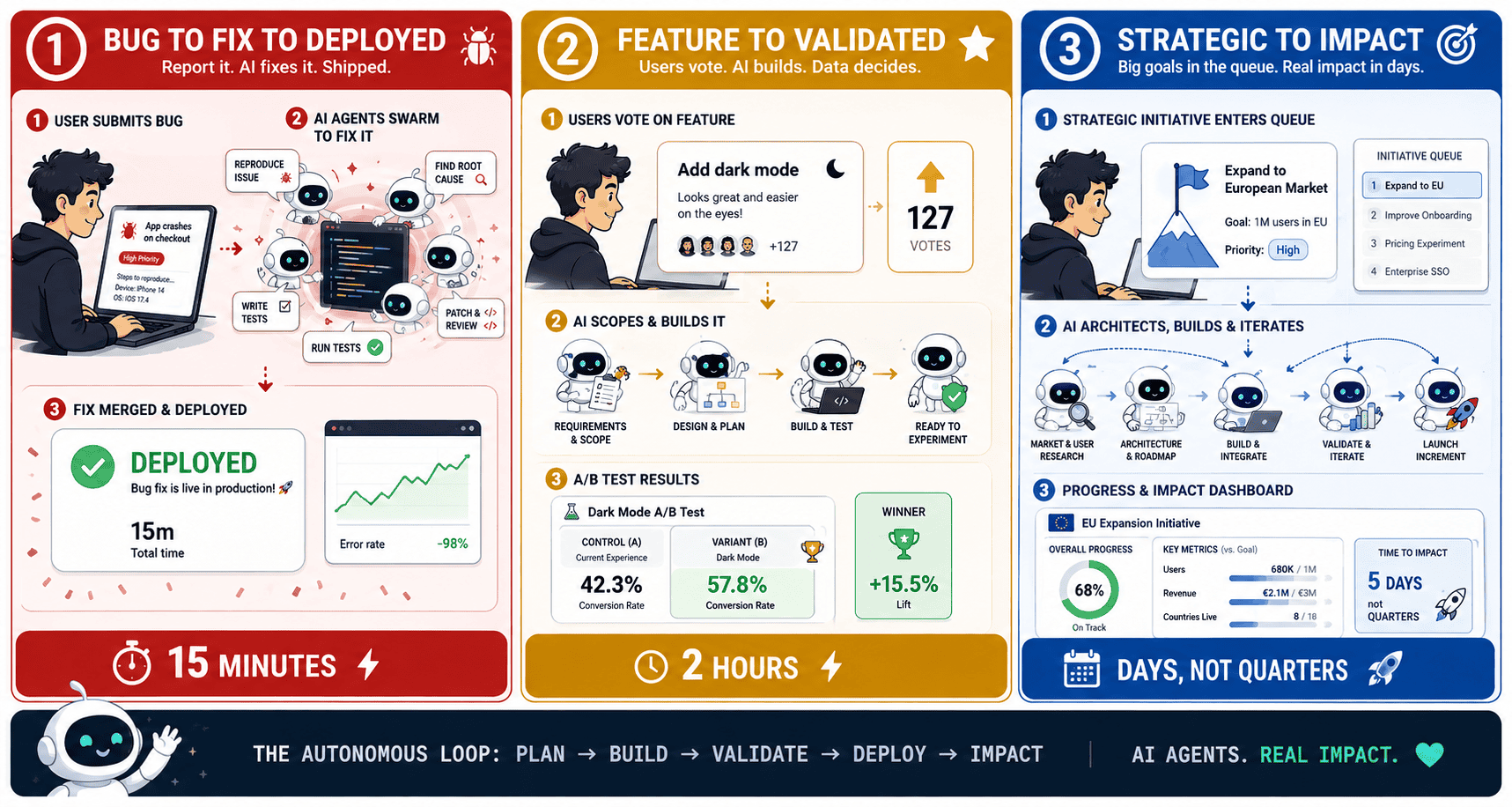
Scenario A: The 15-Minute Bug Fix
A user reports a checkout flow error. The AI system:
- Parses the report, extracts context, and correlates with similar issues
- Reproduces the bug in a sandbox environment
- Identifies the root cause in the payment integration code
- Generates a fix with regression tests
- Runs the full test suite and security scan
- Deploys to a canary environment, monitors for anomalies
- Rolls out to production with automatic rollback triggers
Total elapsed time: 15 minutes. Human touchpoints: zero, unless the fix touches a critical path requiring PM-defined escalation.
Scenario B: The 2-Hour Feature
A feature request for dark mode hits the voting threshold. The AI system:
- Analyzes the request, scopes the implementation, and checks for existing design system components
- Generates the UI changes, theme logic, and user preference storage
- Implements accessibility checks and cross-browser testing
- Deploys to an A/B test environment
- Monitors engagement metrics and user feedback
- Rolls out to all users if metrics meet thresholds
Total elapsed time: 2 hours. Human touchpoints: strategic approval if the feature wasn’t pre-categorized as “auto-ship.”
Scenario C: The Strategic Initiative
The PM injects a strategic priority: “Implement real-time collaboration.” The AI system:
- Architectures the solution, selects appropriate infrastructure (WebSockets, CRDTs, etc.)
- Breaks the work into milestones with dependency mapping
- Implements incrementally, with human review gates at architectural boundaries
- Iterates based on usage patterns and performance data
- Delivers a full working implementation in days, not quarters
Total elapsed time: days. Human touchpoints: architectural review and strategic alignment checks — the high-value work PMs and senior engineers actually want to do.
The Human Role in the Loop
This isn’t about removing humans — it’s about elevating them.
Product Managers become strategic architects. They define the optimization function, set guardrails, and inject business priorities into an otherwise autonomous system. Their job is designing the rules, not pushing the tickets.
Engineers become AI system designers and exception handlers. They build the autonomous infrastructure, define testing and verification standards, and step in when the AI encounters edge cases or architectural decisions that exceed its confidence threshold. They handle the 5% of problems that require human judgment, not the 95% of routine implementation.
Users become co-creators with direct leverage. Their feedback doesn’t disappear into a black hole — it directly shapes the product, often within hours. The product becomes a conversation between user needs and AI execution, with humans setting the direction.
The Risks and Realities
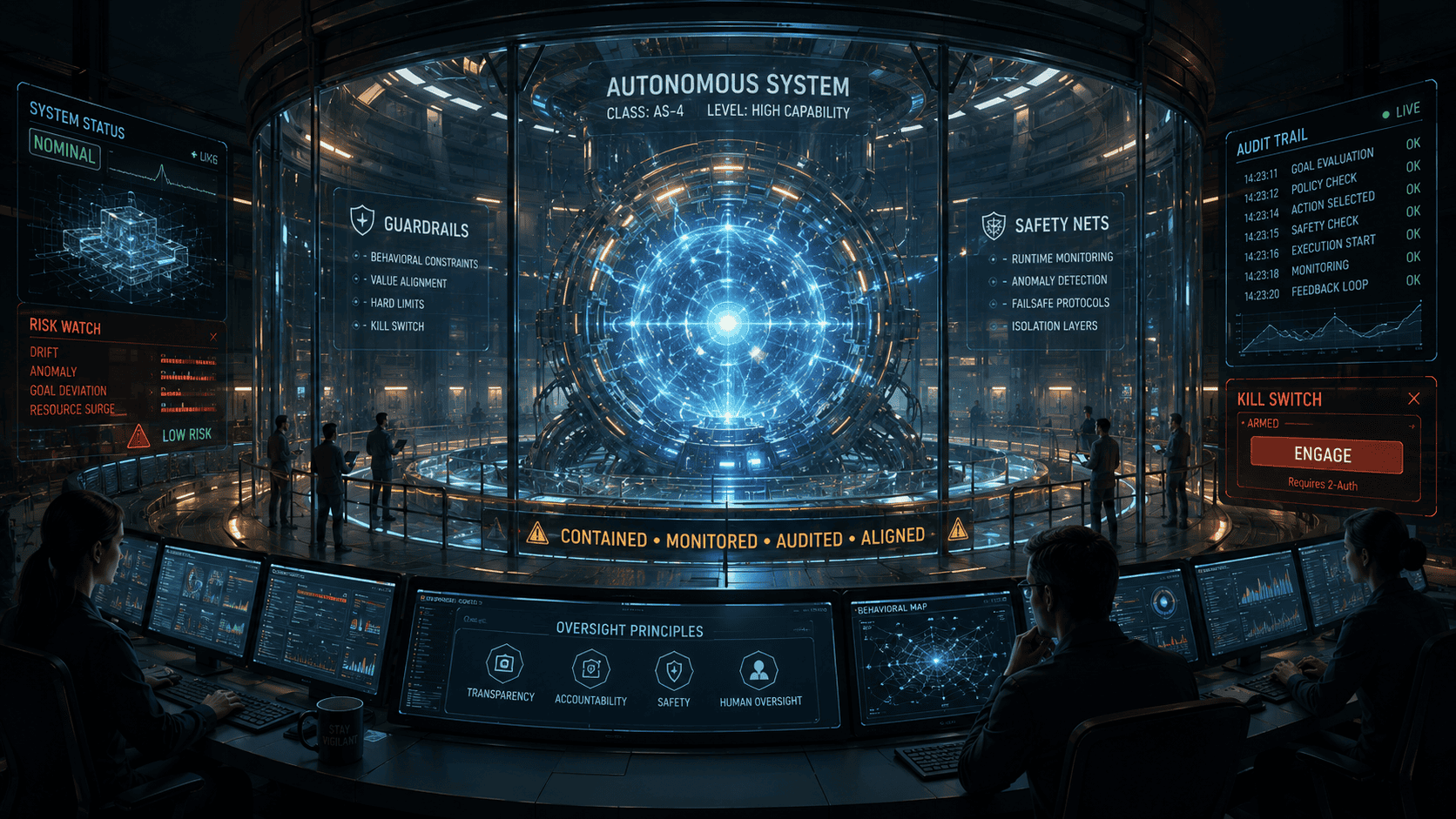
This vision isn’t without challenges. Acknowledging them makes the case stronger, not weaker.
Technical Debt at AI Scale
When AI generates code at machine speed, the codebase grows exponentially. Without strong architectural governance, automated refactoring, and intelligent code review, you risk building a digital junkyard — functional but fragile. The solution is AI-aware code management: automated dependency analysis, intelligent refactoring suggestions, and architectural fitness functions that enforce standards.
Security and Governance
88% of organizations have already experienced AI-related security incidents. Autonomous deployment amplifies this risk — a compromised AI agent could deploy malicious code at machine speed. The answer isn’t manual gates; it’s automated security scanning, behavioral monitoring of AI agents, and cryptographic verification of AI-generated changes. Security must be as autonomous as the development it protects.
The 11-Week Problem
Microsoft Research found it takes 11 weeks for developers to fully realize productivity gains from AI tools. Most give up before then, experiencing only 20% of the potential value. Organizations adopting autonomous development loops will face a similar adoption curve — the infrastructure needs tuning, the AI needs training on your codebase, and the human roles need evolution. Patience and iteration are required.
Cost vs. Speed Tradeoffs
Autonomous execution isn’t free. Compute costs, model licensing, verification overhead, and the cost of getting it wrong all factor in. A bad AI-deployed feature could cost more than the compute saved. The economic model needs careful design — speed is a dial you can turn, but you need to know what you’re paying for each increment.
The Self-Running Loop Is the New North Star
Here’s the shift: tighter feedback loops are no longer the competitive advantage — they’re table stakes. The teams that win will be the ones who build user→development autonomous loops that run themselves, with product managers injecting strategic priorities into a flywheel that never stops turning.
The question isn’t whether this future arrives. The pieces are already here: AI writing half our code, agents running in production, CI/CD pipelines deploying in minutes. The question is who builds the connective tissue first — who closes the gap between “user wants” and “feature live” not by adding more humans, but by designing smarter systems.
The self-running SaaS isn’t science fiction. It’s the inevitable next step in a two-decade arc of automation that started with continuous integration and ends with continuous autonomy.
The pipeline is ready. The loop is waiting to be closed.
What do you think? Are we closer to this future than it feels, or further away than the hype suggests? I’d love to hear your take.

Leave A Comment