
Chat, Agents, APIs, Desktop Tools, and Cross-Device Workflows
The LLM market is no longer just about who has the best model. It is now about product surface area. In practice, that means a few related questions:
- Can I use it in a browser?
- Can it act like an agent, not just a chatbot?
- Does it have an API for developers?
- Does it run on desktop and mobile?
- Can it control local apps, files, and workflows?
- Can it interoperate with other tools, services, or even other models?
That is where the market is getting interesting. The leading vendors are starting to look less like model companies and more like operating environments for AI work.
At a high level, the main players are OpenAI, Anthropic, Google, Microsoft, Perplexity, and xAI. Two other names that matter, depending on your lens, are Meta and Mistral. Meta matters because of Llama and distribution. Mistral matters because of enterprise and open deployment options.
Why these capability categories matter
Before comparing vendors, it helps to define the categories. These are not just feature checkboxes. Each category enables a different mode of work.
| Capability | Why it matters |
|---|---|
| Browser chat | The easiest way for users to start. No install, no setup, immediate access. |
| Browser sandboxed or cloud agent | Lets the model browse, research, click, summarize, and sometimes act in a contained environment without touching your local machine. |
| LLM API | The core developer surface. This is what turns a model into infrastructure for products, automations, and internal tools. |
| Managed hosted agents | Useful when you want long-running or multi-step task execution without building the orchestration stack yourself. |
| Desktop chat | Better for power users, file-heavy workflows, screenshots, and closer integration with the operating system. |
| Desktop CLI or coding agent | The most natural interface for developers working in terminals, repos, and IDE-adjacent workflows. |
| Desktop local agent | This is where things get powerful. A local agent can work with your files, apps, tabs, clipboard, and native workflows. |
| Cross-platform coverage | If a product only works in one place, it limits adoption. Broad platform support matters for consumers and enterprises. |
| Interoperability | This is the future-facing layer. Tool use, connectors, MCP-style protocols, and model orchestration determine how flexible the stack becomes. |
The high-level market map
Here is the short version. Some vendors are strongest in browser and cloud workflows. Others are strongest on desktop and local execution. Some have deep enterprise orchestration but weaker consumer surfaces. Some have surprisingly broad product footprints that are still underappreciated.
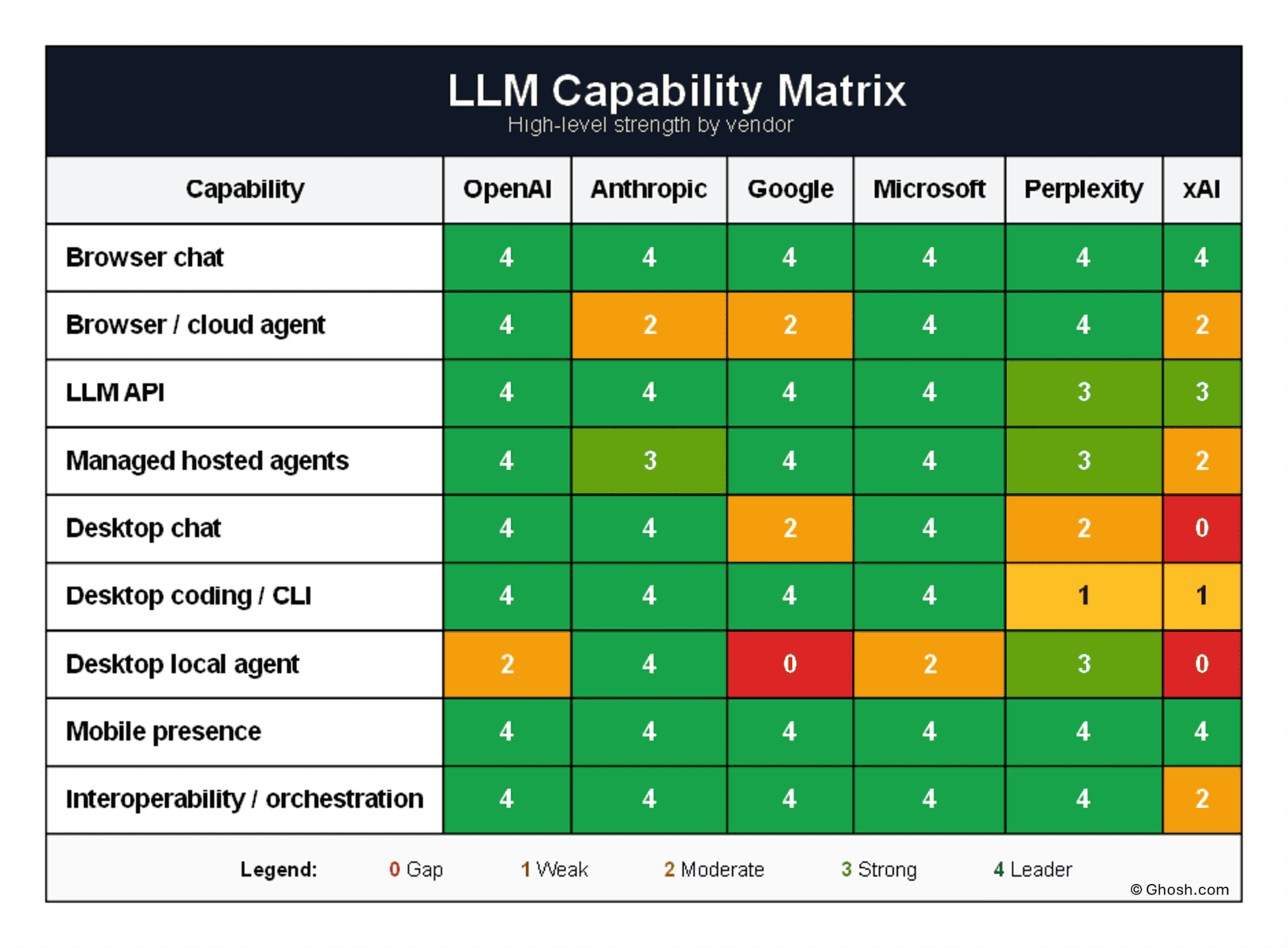
This table is intentionally high level. The goal is not to list every SKU or beta. The goal is to show where each vendor is clearly strong, where they are partial, and where there is still a gap.
| Category | OpenAI | Anthropic | Microsoft | Perplexity | xAI | |
|---|---|---|---|---|---|---|
| Browser chat | Strong | Strong | Strong | Strong | Strong | Strong |
| Browser sandboxed or cloud agent | Strong | Partial | Partial | Strong | Strong | Partial |
| LLM API | Strong | Strong | Strong | Strong | Strong | Strong |
| Managed hosted agents | Strong | Strong | Strong | Strong | Strong | Partial |
| Desktop chat | Strong | Strong | Partial | Strong | Partial | Gap |
| Desktop CLI or coding agent | Strong | Strong | Strong | Strong | Gap | Gap |
| Desktop local agent | Partial | Strong | Gap | Partial | Strong on Mac | Gap |
| Browser platform | Yes | Yes | Yes | Yes | Yes | Yes |
| Windows desktop | Yes | Yes | Partial | Yes | Partial | Unclear |
| macOS desktop | Yes | Yes | Partial | Yes | Yes | Unclear |
| Android | Yes | Yes | Yes | Yes | Yes | Yes |
| iPhone | Yes | Yes | Yes | Yes | Yes | Yes |
| Interoperability and orchestration | Strong | Strong | Strong | Very strong | Very strong | Partial to strong |
How to read the vendor landscape
OpenAI: strongest in cloud agents plus coding surfaces
OpenAI has one of the broadest product stacks. Browser chat is mature. Desktop is mature. Mobile is mature. The API is foundational. It also has a strong coding story through Codex and related developer tools.
Where OpenAI stands out is in cloud-based agent workflows. The company has pushed hard on agents that act in a browser or hosted environment rather than directly operating your local machine. That makes its stack feel more like a cloud operating layer than a local assistant.
If Anthropic is strongest on “AI working on your computer,” OpenAI is strongest on “AI working on a computer for you.”
Anthropic: strongest on the desktop-local agent idea
Anthropic has built one of the most coherent product stacks in the market. Claude has browser chat, desktop chat, mobile apps, API access, coding surfaces, and most importantly a clear local desktop agent story through Cowork.
That matters because desktop-local agents are a different category from browser agents. They can touch files, apps, windows, browser tabs, and native workflows in a much more direct way.
Anthropic also has an interesting cross-device angle. The Claude mobile app can hand off work to a live desktop session. That is not just a convenience feature. It hints at where the market is going: one assistant across multiple devices and execution surfaces.
The main gap is also obvious. Cowork is not really a browser-native experience. It is fundamentally a desktop product.
Google: broad platform, strong APIs, thinner desktop identity
Google has huge reach and a deep enterprise stack. Gemini is strong in the browser and on mobile. Google also has Gemini API access, developer tools, and enterprise agent infrastructure through Vertex and related services.
What feels less defined is the standalone desktop story. Google has integrations, Chrome surfaces, coding tools, and strong cloud infrastructure, but not yet the same kind of consumer-facing desktop identity that ChatGPT or Claude has.
In other words, Google is broad and powerful, but the experience is more distributed across products and surfaces.
Microsoft: the broadest enterprise orchestration layer
Microsoft deserves more credit in this conversation. If you combine Copilot, GitHub Copilot, Copilot Studio, and Azure Foundry, Microsoft has one of the most complete AI portfolios in the market.
Consumer chat is covered. Desktop is covered. Coding is covered. Enterprise agent creation is covered. Multi-agent orchestration is covered. In many ways, Microsoft has the most complete enterprise map.
The tradeoff is complexity. The portfolio is broader than Anthropic’s or OpenAI’s, but also more fragmented. It is more of a platform family than a single clean product line.
Perplexity: from answer engine to serious agent platform
Perplexity started in most people’s minds as a better search experience. That framing is now too narrow.
Perplexity increasingly looks like a full AI work platform. It has browser chat, mobile apps, an agentic browser story, a desktop angle, and an API layer that can route across multiple model providers.
That last piece is especially important. Perplexity’s stack is notably strong on interoperability. It is one of the more interesting vendors if you care less about one proprietary model and more about coordinating the best available capabilities across vendors.
Its main weakness is the coding and developer CLI layer. Compared with OpenAI, Anthropic, Google, and Microsoft, Perplexity is not yet the strongest first-choice developer workstation.
xAI: consumer reach plus API, but thinner work surfaces
xAI has moved quickly on consumer visibility. Grok has strong awareness, real-time search, and broad interest from users who want an AI product closely tied to live information flows.
It also has API and tool capabilities. But compared with the leaders, its product surface still looks thinner in the areas that matter most for serious workflow replacement: desktop apps, developer CLI, and local desktop agents.
That does not mean xAI is weak. It means the current strength is narrower and more centered on chat, search, and API use than on end-to-end agent work environments.
The most important distinction in the market
The market is starting to split into two overlapping but distinct models:
- Cloud-first agent platforms
- Local desktop agent platforms
Cloud-first agent platforms are best when you want safety, scale, parallelism, and hosted execution. These are ideal for research, browser automation, and managed workflows.
Local desktop agent platforms are best when you want the AI to work inside your real environment. That means your desktop, your apps, your clipboard, your files, and your browser session.
Right now, Anthropic is the clearest example of the second category. OpenAI is the clearest example of the first. Perplexity is interesting because it is trying to bridge both worlds.
The next layer: interoperability
One of the biggest shifts underway is that the winning vendors may not be the ones with the single best model. They may be the ones with the best interoperability layer.
That means:
- tool calling
- connectors
- model context protocols
- hosted agent frameworks
- cross-device continuity
- multi-model orchestration
This is where the comparison gets more strategic. A model is valuable. A model that can coordinate with other services, invoke tools, delegate work, and maintain context across devices is much more valuable.
That is also why this category matters so much for product builders. The question is no longer just “Which model should I use?” The better question is “Which AI stack can participate in a broader workflow system?”
Who else matters?
Two other players should stay on the radar even if they do not fit as neatly into the table above.
Meta
Meta matters because of Llama, distribution, and ecosystem reach. It is less cleanly packaged as one unified work platform, but it remains one of the most important forces in open and semi-open model distribution.
Mistral
Mistral matters because it offers a credible alternative for enterprises that care about flexibility, sovereignty, or a less vertically integrated stack. It is particularly relevant in markets where deployment control matters as much as product polish.
The simple takeaway
If you want the shortest possible summary, here it is:
- Best desktop-local agent: Anthropic
- Best cloud-agent plus coding bundle: OpenAI
- Best enterprise orchestration breadth: Microsoft
- Best Google-stack enterprise and API story: Google
- Most interesting research-first agent hybrid: Perplexity
- Strong consumer chat plus live-info position: xAI
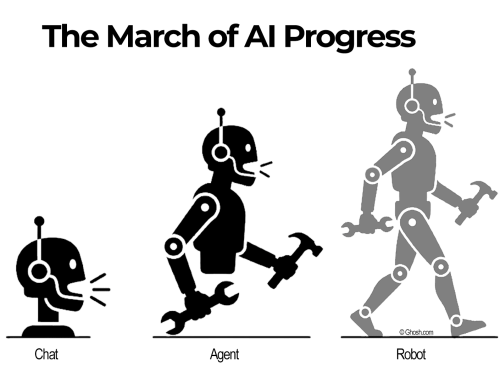
The bigger conclusion is that the market is no longer converging on a single form factor. It is expanding into a full AI product stack: browser, cloud agent, API, coding environment, desktop app, mobile app, and local machine control.
That means future comparisons will matter less at the model level alone and more at the workflow level. The real question is not just who has the smartest model. It is who has built the most useful environment around it.
And increasingly, that environment is the product.


Leave A Comment