

[playht_player width=”100%” height=”175″ voice=”Noah”]
It’s disappointing that Microsoft Excel still does not support dates before January 1, 1900. I recently was exporting data from another application into Excel and was painfully reminded of this limitation. Here’s a summary of how I converted and stored the mixed dates, some from before 1900 and some after.
First, I decided to break down all dates and store the year, month, and day separately for each date — i.e., in separate columns.
For the post-1900 dates, this was simple:
Year = YEAR(A1). Month = MONTH(A1). Day = DAY(A1).
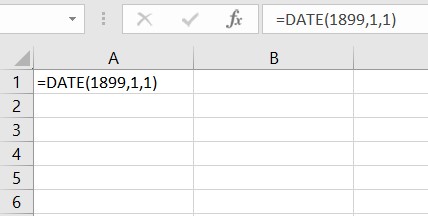
The dates prior to 1900 came in as large numbers like 4294966821. With some reference checks to original data, I realized that 4294967297 was equivalent to December 31, 1899 and that the difference was number of days. I used 4294966933 as my reference for January 1, 1899 and relative difference in number of days.
B1=A1-4294966933
But I wanted to use Excel’s built in ability to account for leap years, etc, so I’d have to use a valid date. Thus, I added 1000 years to make the date valid:
C1=DATE(2899,1,1) + B1
Then, remember to take a 1000 off of the year again:
Year = YEAR(C1)-1000. Month = MONTH(C1). Day = DAY(C1).
Done!
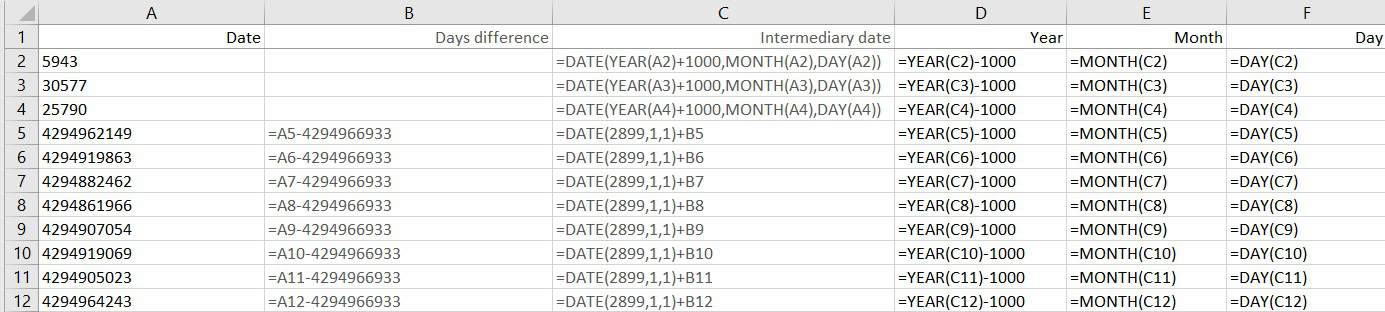
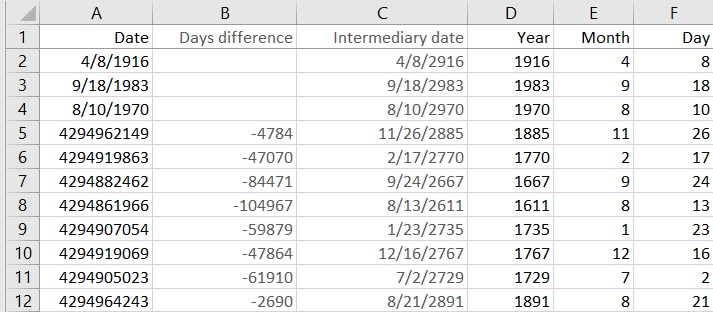
Below is example screenshot of formulas and values. I hope this saves someone a bunch of time.
Formulas
Values

the leap cycle is 400 years. 1000 does not evenly divide by 400. you should use an multiple of 400 years, instead, depending on how far back your sheet needs to go: 400, 800, 1200, 1600, 2000, 2400, 2800, 3200, 3600, 4000, etc